Never trust a white man,
Never kill a Jew,
Never sign a contract,
Never rent a pew.
Don't enlist in armies;
Nor marry many wives;
Never write for magazines;
Never scratch your hives.
Always put paper on the seat,
Don't believe in wars,
Keep yourself both clean and neat,
Never marry whores.
Never pay a blackmailer,
Never go to law,
Never trust a publisher,
Or you'll sleep on straw.
All your friends will leave you
All your friends will die
So lead a clean and wholesome life
And join them in the sky.
You declare you see me dimly
through a glass which will not shine,
though I stand before you boldly,
trim in rank and marking time.
You do own to hear me faintly
as a whisper out of range,
while my drums beat out the message
and the rhythms never change.
Equality, and I will be free.
Equality, and I will be free.
You announce my ways are wanton,
that I fly from man to man,
but if I'm just a shadow to you,
could you ever understand ?
We have lived a painful history,
we know the shameful past,
but I keep on marching forward,
and you keep on coming last.
Equality, and I will be free.
Equality, and I will be free.
Take the blinders from your vision,
take the padding from your ears,
and confess you've heard me crying,
and admit you've seen my tears.
Hear the tempo so compelling,
hear the blood throb in my veins.
Yes, my drums are beating nightly,
and the rhythms never change.
Equality, and I will be free.
Equality, and I will be free.
She came home running
back to the mothering blackness
deep in the smothering blackness
white tears icicle gold plains of her face
She came home running
She came down creeping
here to the black arms waiting
now to the warm heart waiting
rime of alien dreams befrosts her rich brown face
She came down creeping
She came home blameless
black yet as Hagar’s daughter
tall as was Sheba’s daughter
threats of northern winds die on the desert’s face
She came home blameless
“The New Colossus” by Emma Lazarus (1849-1887)
Not like the brazen giant of Greek fame,
With conquering limbs astride from land to land;
Here at our sea-washed, sunset gates shall stand
A mighty woman with a torch, whose flame
Is the imprisoned lightning, and her name
Mother of Exiles. From her beacon-hand
Glows world-wide welcome; her mild eyes command
The air-bridged harbor that twin cities frame.
“Keep, ancient lands, your storied pomp!” cries she
With silent lips. “Give me your tired, your poor,
Your huddled masses yearning to breathe free,
The wretched refuse of your teeming shore.
Send these, the homeless, tempest-tossed to me,
I lift my lamp beside the golden door!”
“Ode on a Grecian Urn” by John Keats (1795-1821)
Thou still unravish’d bride of quietness,
Thou foster-child of silence and slow time,
Sylvan historian, who canst thus express
A flowery tale more sweetly than our rhyme:
What leaf-fring’d legend haunts about thy shape
Of deities or mortals, or of both,
In Tempe or the dales of Arcady?
What men or gods are these? What maidens loth?
What mad pursuit? What struggle to escape?
What pipes and timbrels? What wild ecstasy?
Heard melodies are sweet, but those unheard
Are sweeter; therefore, ye soft pipes, play on;
Not to the sensual ear, but, more endear’d,
Pipe to the spirit ditties of no tone:
Fair youth, beneath the trees, thou canst not leave
Thy song, nor ever can those trees be bare;
Bold Lover, never, never canst thou kiss,
Though winning near the goal yet, do not grieve;
She cannot fade, though thou hast not thy bliss,
For ever wilt thou love, and she be fair!
Who are these coming to the sacrifice?Ah, happy, happy boughs! that cannot shed
Your leaves, nor ever bid the Spring adieu;
And, happy melodist, unwearied,
For ever piping songs for ever new;
More happy love! more happy, happy love!
For ever warm and still to be enjoy’d,
For ever panting, and for ever young;
All breathing human passion far above,
That leaves a heart high-sorrowful and cloy’d,
A burning forehead, and a parching tongue.
To what green altar, O mysterious priest,
Lead’st thou that heifer lowing at the skies,
And all her silken flanks with garlands drest?
What little town by river or sea shore,
Or mountain-built with peaceful citadel,
Is emptied of this folk, this pious morn?
And, little town, thy streets for evermore
Will silent be; and not a soul to tell
Why thou art desolate, can e’er return.
O Attic shape! Fair attitude! with brede
Of marble men and maidens overwrought,
With forest branches and the trodden weed;
Thou, silent form, dost tease us out of thought
As doth eternity: Cold Pastoral!
When old age shall this generation waste,
Thou shalt remain, in midst of other woe
Than ours, a friend to man, to whom thou say’st,
“Beauty is truth, truth beauty,—that is all
Ye know on earth, and all ye need to know.”
“The Tiger” by William Blake (1757-1827)
Tiger Tiger, burning bright,
In the forests of the night;
What immortal hand or eye,
Could frame thy fearful symmetry?
In what distant deeps or skies.
Burnt the fire of thine eyes?
On what wings dare he aspire?
What the hand, dare seize the fire?
And what shoulder, and what art,
Could twist the sinews of thy heart?
And when thy heart began to beat,
What dread hand? and what dread feet?
What the hammer? what the chain,
In what furnace was thy brain?
What the anvil? what dread grasp,
Dare its deadly terrors clasp!
When the stars threw down their spears
And water’d heaven with their tears:
Did he smile his work to see?
Did he who made the Lamb make thee?
Tiger Tiger burning bright,
In the forests of the night:
What immortal hand or eye,
Dare frame thy fearful symmetry?
“On His Blindness” by John Milton (1608-1674)
When I consider how my light is spent
Ere half my days in this dark world and wide,
And that one talent which is death to hide
Lodg’d with me useless, though my soul more bent
To serve therewith my Maker, and present
My true
account, lest he returning chide,
“Doth God exact day-labour, light denied?”
I fondly ask. But Patience, to prevent
That murmur, soon replies: “God doth not need
Either man’s work or his own gifts: who best
Bear his mild yoke, they serve him best. His state
Is kingly; thousands at his bidding speed
What the heart of the young man said to the Psalmist
Tell me not, in mournful numbers,
Life is but an empty dream!
For the soul is dead that slumbers,
And things are not what they seem.
Life is real! Life is earnest!
And the grave is not its goal;
Dust thou art, to dust returnest,
Was not spoken of the soul.
Not enjoyment, and not sorrow,
Is our destined end or way;
But to act, that each tomorrow
Find us farther than today.
Art is long, and Time is fleeting,
And our hearts, though stout and brave,
Still, like muffled drums, are beating
Funeral marches to the grave.
In the world’s broad field of battle,
In the bivouac of Life,
Be not like dumb, driven cattle!
Be a hero in the strife!
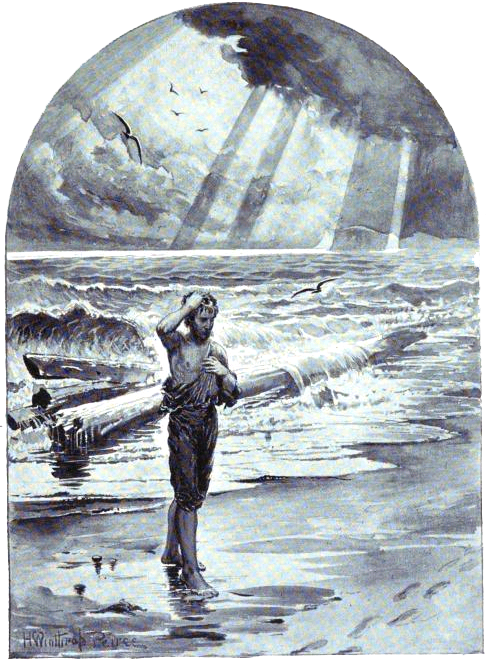
Trust no Future, howe’er pleasant!
Let the dead Past bury its dead!
Act,—act in the living Present!
Heart within, and God o’erhead!
Lives of great men all remind us
We can make our lives sublime,
And, departing, leave behind us
Footprints on the sands of time;—
Footprints, that perhaps another,
Sailing o’er life’s solemn main,
A forlorn and shipwrecked brother,
Seeing, shall take heart again.
Let us, then, be up and doing,
With a heart for any fate;
Still achieving, still pursuing,
Learn to labor and to wait.
I wandered lonely as a cloud
That floats on high o’er vales and hills,
When all at once I saw a crowd,
A host, of golden daffodils;
Beside the lake, beneath the trees,
Fluttering and dancing in the breeze.
Continuous as the stars that shine
And twinkle on the milky way,
They stretched in never-ending line
Along the margin of a bay:
Ten thousand saw I at a glance,
Tossing their heads in sprightly dance.
The waves beside them danced; but they
Out-did the sparkling waves in glee:
A poet could not but be gay,
In such a jocund company:
I gazed—and gazed—but little thought
What wealth the show to me had brought:
For oft, when on my couch I lie
In vacant or in pensive mood,
They flash upon that inward eye
Which is the bliss of solitude;
And then my heart with pleasure fills,
And dances with the daffodils.
BJM
And post o’er land and ocean without rest:
They also serve who only stand and wait.”
Daddy
by Sylvia Plath
You do not do, you do not do
Any more, black shoe
In which I have lived like a foot
For thirty years, poor and white,
Barely daring to breathe or Achoo.
Daddy, I have had to kill you.
You died before I had time--
Marble-heavy, a bag full of God,
Ghastly statue with one gray toe
Big as a Frisco seal
And a head in the freakish Atlantic
Where it pours bean green over blue
In the waters off beautiful Nauset.
I used to pray to recover you.
Ach, du.
In the German tongue, in the Polish town
Scraped flat by the roller
Of wars, wars, wars.
But the name of the town is common.
My Polack friend
Says there are a dozen or two.
So I never could tell where you
Put your foot, your root,
I never could talk to you.
The tongue stuck in my jaw.
It stuck in a barb wire snare.
Ich, ich, ich, ich,
I could hardly speak.
I thought every German was you.
And the language obscene
An engine, an engine
Chuffing me off like a Jew.
A Jew to Dachau, Auschwitz, Belsen.
I began to talk like a Jew.
I think I may well be a Jew.
The snows of the Tyrol, the clear beer of Vienna
Are not very pure or true.
With my gipsy ancestress and my weird luck
And my Taroc pack and my Taroc pack
I may be a bit of a Jew.
I have always been scared of you,
With your Luftwaffe, your gobbledygoo.
And your neat mustache
And your Aryan eye, bright blue.
Panzer-man, panzer-man, O You--
Not God but a swastika
So black no sky could squeak through.
Every woman adores a Fascist,
The boot in the face, the brute
Brute heart of a brute like you.
You stand at the blackboard, daddy,
In the picture I have of you,
A cleft in your chin instead of your foot
But no less a devil for that, no not
Any less the black man who
Bit my pretty red heart in two.
I was ten when they buried you.
At twenty I tried to die
And get back, back, back to you.
I thought even the bones would do.
But they pulled me out of the sack,
And they stuck me together with glue.
And then I knew what to do.
I made a model of you,
A man in black with a Meinkampf look
And a love of the rack and the screw.
And I said I do, I do.
So daddy, I'm finally through.
The black telephone's off at the root,
The voices just can't worm through.
If I've killed one man, I've killed two--
The vampire who said he was you
And drank my blood for a year,
Seven years, if you want to know.
Daddy, you can lie back now.
There's a stake in your fat black heart
And the villagers never liked you.
They are dancing and stamping on you.
They always knew it was you.
Daddy, daddy, you bastard, I'm through.
Love and Friendship
by Emily Bronte
Love is like the wild rose-briar,
Friendship like the holly-tree
The holly is dark when the rose-briar blooms
But which will bloom most constantly?
The wild-rose briar is sweet in the spring,
Its summer blossoms scent the air;
Yet wait till winter comes again
And who will call the wild-briar fair?
Then scorn the silly rose-wreath now
And deck thee with the holly's sheen,
That when December blights thy brow
He may still leave thy garland green.
The Definition Of Love
by Andrew Marvell
My love is of a birth as rare
As 'tis for object strange and high:
It was begotten by Despair
Upon Impossibility.
Magnanimous Despair alone
Could show me so divine a thing,
Where feeble Hope could ne'er have flown
But vainly flapped its tinsel wing.
And yet I quickly might arrive
Where my extended soul is fixed
But Fate does iron wedges drive,
And always crowds itself betwixt.
For Fate with jealous eye does see
Two perfect loves, nor lets them close:
Their union would her ruin be,
And her tyrranic power depose.
And therefore her decrees of steel
Us as the distant Poles have placed
(Though Love's whole world on us doth wheel)
Not by themselves to be embraced,
Unless the giddy heaven fall,
And earth some new convulsion tear;
And, us to join, the world should all
Be cramped into a planisphere.
As lines (so loves) oblique may well
Themselves in every angle greet:
But ours so truly parallel,
Though infinite, can never meet.
Therefore the love which us doth bind,
But Fate so enviously debars,
Is the conjunction of the mind,
And opposition of the stars.
I Taught Myself To Live Simply
by Anna Akhmatova
I taught myself to live simply and wisely,
to look at the sky and pray to God,
and to wander long before evening
to tire my superfluous worries.
When the burdocks rustle in the ravine
and the yellow-red rowanberry cluster droops
I compose happy verses
about life's decay, decay and beauty.
I come back. The fluffy cat
licks my palm, purrs so sweetly
and the fire flares bright
on the saw-mill turret by the lake.
Only the cry of a stork landing on the roof
occasionally breaks the silence.
If you knock on my door
I may not even hear.
A Poet To His Beloved
by William Butler Yeats
I BRING you with reverent hands
The books of my numberless dreams,
White woman that passion has worn
As the tide wears the dove-grey sands,
And with heart more old than the horn
That is brimmed from the pale fire of time:
White woman with numberless dreams,
I bring you my passionate rhyme.
Always for the first time
by Andre Breton
Always for the first time
Hardly do I know you by sight
You return at some hour of the night to a house at an angle to my window
A wholly imaginary house
It is there that from one second to the next
In the inviolate darkness
I anticipate once more the fascinating rift occuring
The one and only rift
In the facade and in my heart
The closer I come to you
In reality
The more the key sings at the door of the unknown room
Where you appear alone before me
At first you coalesce entierly with the brightness
The elusive angle of a curtain
It's a field of jasmine I gazed upon at dawn on a road in the vicinity of Grasse
With the diagonal slant of its girls picking
Behind them the dark falling wing of the plants stripped bare
Before them a T-square of dazzling light
The curtain invisibly raised
In a frenzy all the flowers swarm back in
It is you at grips with that too long hour never dim enough until sleep
You as though you could be
The same except that I shall perhaps never meet you
You pretend not to know I am watching you
Marvelously I am no longer sure you know
You idleness brings tears to my eyes
A swarm of interpretations surrounds each of your gestures
It's a honeydew hunt
There are rocking chairs on a deck there are branches that may well scratch you in the forest
There are in a shop window in the rue Notre-Dame-de-Lorette
Two lovely crossed legs caught in long stockings
Flaring out in the center of a great white clover
There is a silken ladder rolled out over the ivy
There is
By my leaning over the precipice
Of your presence and your absense in hopeless fusion
My finding the secret
Of loving you
Always for the first time.


By Rudyard Kipling
Are losing theirs and blaming it on you,
If you can trust yourself when all men doubt you,
But make allowance for their doubting too;
If you can wait and not be tired by waiting,
Or being lied about, don’t deal in lies,
Or being hated, don’t give way to hating,
And yet don’t look too good, nor talk too wise:
If you can think—and not make thoughts your aim;
If you can meet with Triumph and Disaster
And treat those two impostors just the same;
If you can bear to hear the truth you’ve spoken
Twisted by knaves to make a trap for fools,
Or watch the things you gave your life to, broken,
And stoop and build ’em up with worn-out tools:
And risk it on one turn of pitch-and-toss,
And lose, and start again at your beginnings
And never breathe a word about your loss;
If you can force your heart and nerve and sinew
To serve your turn long after they are gone,
And so hold on when there is nothing in you
Except the Will which says to them: ‘Hold on!’
Or walk with Kings—nor lose the common touch,
If neither foes nor loving friends can hurt you,
If all men count with you, but none too much;
If you can fill the unforgiving minute
With sixty seconds’ worth of distance run,
Yours is the Earth and everything that’s in it,
And—which is more—you’ll be a Man, my son!
By Walt Whitman (1819-1892)
the prize we sought is won, The port is near, the bells I hear, the people all exulting,
While follow eyes the steady keel, the vessel grim and daring; But O heart! heart! heart!
O the bleeding drops of red, Where on the deck my Captain lies, Fallen cold and dead.
O Captain! my Captain! rise up and hear the bells; Rise up- for you the flag is flung- for
you the bugle trills,
a-crowding,
For you they call, the swaying mass, their eager faces turning;
Here Captain! dear father!
This arm beneath your head!
It is some dream that on the deck,
You’ve fallen cold and dead.
My father does not feel my arm, he has no pulse nor will,
The ship is anchor’d safe and sound, its voyage closed and done,
From fearful trip the victor ship comes in with object won;
Exult O shores, and ring O bells!
But I with mournful tread,
Walk the deck my Captain lies,
Fallen cold and dead.